67-Year-Old Traditional Birth Attendant Reveals the Forgotten Postpartum Method That Helped Nigerian Women Flatten Their Baby Belly and Restore Their Waistline After Every Birth — Without Gym, Surgery, or Starving While Breastfeeding
Being a new mother in Nigeria should feel like a celebration.
But when you look in the mirror, it doesn’t feel like one.
It feels like a loss.
Not a loss anyone warns you about.
Not a loss anyone wants to talk about.
The kind you carry quietly, alone, behind your smile.
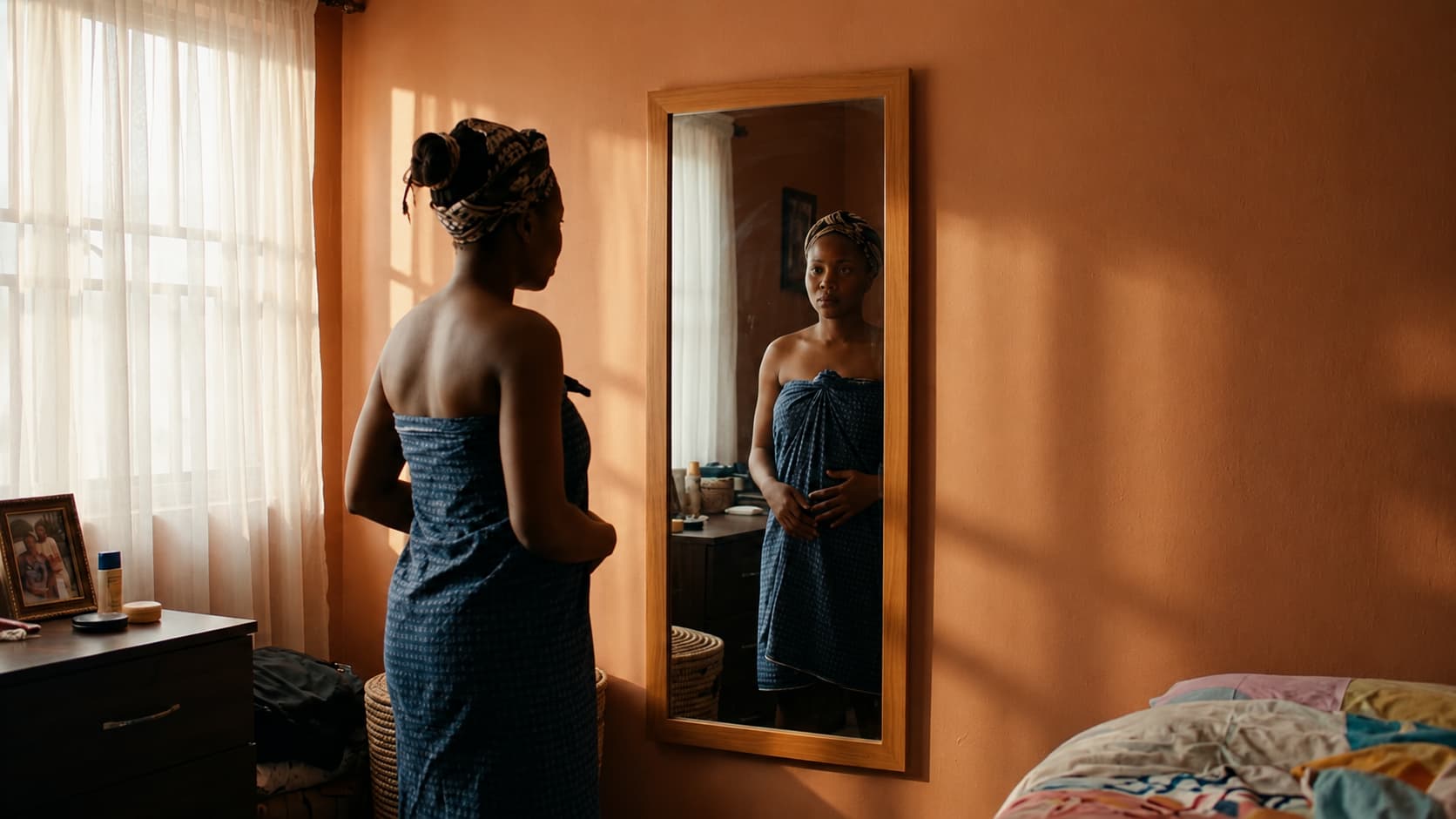
You stand sideways in the bathroom mirror before anyone else wakes up — tilting the angle, hoping a different view will show something different.
It doesn’t.
The belly that sat there for 9 months is still sitting there. Loose. Round. Stubborn. Like it didn’t get the message that the baby already came out.
Your waist — the one your husband used to trace with his hands — is gone. Replaced by a softness that spills over the waistband of every pair of trousers you own.
You pull your blouse down to cover it. You tie your wrapper tighter to create the illusion of a waist. You tell yourself you just need more time.
But time has been passing. And nothing is changing.
It’s been 7 months since you gave birth. 10 months. A year. And your body still doesn’t feel like yours.
You’ve seen the way your husband behaves now. Not aggressive, not cruel. Just… different.
The calls have gotten shorter. The interest has cooled. He comes home, eats, and goes straight to his phone.
You remember how he used to look at you. Before the baby. Before your body changed. He used to reach for you in the middle of the night just to hold you. Now he turns to his side of the bed.
And sometimes, when you’re both at an event, you catch him. Looking at a woman across the room. The kind who looks like she has never had a baby in her life. Flat stomach, fitted dress, everything in place.
And in that millisecond, you feel it. The comparison. The gap. The thing that has quietly opened between you.
Late at night, when the baby is finally asleep and the house is quiet, the thoughts come:
“Is this why he’s become distant? Is it my body?”
“Does he look at me and see a wife… or just the mother of his child?”
“Will I ever get my body back? Or is this just… who I am now?”
You push the thoughts away. You tell yourself you’re being insecure. That a good man doesn’t care about your postpartum body.
But deep down, in the honest part of you that doesn’t lie, you know something has shifted.
And no amount of “body positivity” quotes on Instagram will fix the look on his face when he thinks you’re not watching.
You’ve tried to fix it. The waist trainers, the slimming teas, the meal plans. You’ve been half-starving yourself while breastfeeding and still nothing shifts from your belly.
Every sacrifice. No results. Just exhaustion added to the frustration.
If you’ve been quietly carrying this — the fear of losing your husband’s desire, the embarrassment in fitted clothes, the grief of a body that used to be yours — every word on this page was written for you.
Because this was my story, exactly my story, down to the last painful detail.
And what I’m about to share with you changed everything for me.
Not surgery. Not a gym plan designed for an already-exhausted new mother. Not another slimming tea that dehydrates you and does nothing else.
A forgotten postpartum recovery method that Nigerian women used for generations to melt baby weight naturally, restore their waistline, and return to their bodies faster than anyone thought possible.
A method nearly lost completely. Until I found the woman who still knew it.
My name is Kemi.

I’m 30 years old. I live and work in Lagos.
I’m NOT a doctor. I’m NOT a fitness coach. I’m NOT one of those Instagram body transformation experts selling ₦50,000 gym plans.
I’m just a Nigerian woman who had a baby, lost herself in the process, and found her way back.
Let me tell you my story.
The Man Who Made Me Feel Like Home
His name was Emeka.
We met at a colleague’s wedding in Ikeja. I was at the cocktail table, laughing at something my friend said, when he appeared beside me.
“What’s funny?” he asked. Zero shame. Like we’d known each other for years.
He was confident without being arrogant. Warm without being soft. We talked for two hours that night and I remember thinking: this one is different.
Three years later, we got married. And then, 14 months into our marriage, we had our son. Tobenna.
The pregnancy was beautiful. Emeka was present for everything — the scans, the midnight food cravings, the false alarms. He held my hand in the delivery room and cried when Tobenna came out.
“You’re incredible,” he whispered. “You grew an entire human being. I’m so proud of you.”
I felt more loved in that moment than at any point in my life. I thought having this baby would bring us even closer.
I was half right.
When The Body Doesn’t Come Back
The first three months, I didn’t think about my body. I was surviving — breastfeeding every two hours, sleeping in broken intervals, learning a whole new language of cries and cues.
But around month four, I started to notice small things. I’d catch my reflection and barely recognise the woman staring back at me.
My belly — which I’d been told would “snap back” — was still there. Soft and round. My waist, the one I’d always been proud of, had disappeared into a straight, thick silhouette.
I started avoiding fitted clothes. Started wearing looser tops. Started angling away from mirrors.
Then one evening, Emeka and I went for a birthday dinner in Victoria Island. I wore the nicest blouse I could fit into, belted at the waist to try to create some shape.
Emeka looked at me and said: “You look nice.”
Two words. Flat delivery. Eyes back to the menu.
I thought about how he used to look at me before. The way he’d stand back and look — properly look — with that smile that said I’m the luckiest man alive.
That look was gone. He didn’t say anything cruel. He didn’t do anything wrong. But the absence said everything.
Later that night, when he fell asleep, I unlocked my phone and typed: “how to lose postpartum belly fat fast.”
And that’s how the expensive, exhausting, humiliating chapter of my life began.
The Year I Tried Everything
What followed was over a year of wasted money and wasted hope.
The waist trainer. Everyone recommended it. I bought one for ₦26,500. Wore it for six weeks. Sweated under it. Couldn’t breathe properly. The moment I took it off, everything went back to exactly where it was. ₦26,500 wasted and a heat rash to show for it.
The slimming tea. I ordered 3 packs for ₦39,000. It rushed me to the toilet three times a day. My breastmilk tasted different and Tobenna rejected the breast for two days. My belly didn’t change. ₦39,000 gone and a disrupted breastfeeding relationship.
The postpartum meal plan. A fitness influencer sold a “mummy tummy gone in 30 days” plan for ₦18,000. It was calorie-restricted and ignored breastfeeding mothers’ nutritional needs entirely. My milk supply dropped so badly I cried in the bathroom. My midwife told me to stop immediately. ₦18,000 for a plan that nearly cost my son his nutrition.
The gym. When Tobenna was 8 months old, I paid ₦12,000 for membership and ₦20,000 for a postpartum trainer. Three months of squatting and lunging. The belly fat? Still there. ₦32,000 and 3 months of exhaustion. Same body.
I sat on the edge of my bed one Sunday afternoon and counted.
Over ₦115,000 spent. Over a year gone. My body had barely changed.
And somewhere inside me, the question I was afraid to say out loud was getting louder:
“Is this just my body now? Is this who I am forever?”
What Nobody Told Me (Until An Old Woman Did)
Here is what I eventually learned. And this is the part that changed everything:
Every single thing I tried made the same fundamental mistake. They all treated postpartum fat like regular fat. It is not.
Postpartum fat — especially the belly fat that sits below the navel after birth — is hormonally different. Your body stored it specifically to support pregnancy and lactation, and it will hold onto it until it receives the right hormonal and nutritional signal that it is safe to release.
Restricting calories doesn’t send that signal. Waist trainers don’t. Gym workouts don’t. In fact, extreme dieting and over-exercise raise cortisol — which actively tells your body to hold on even tighter.
Our grandmothers knew this. The specific foods, the herbal preparations, the body technique — all of it was designed to send the body the signal to release postpartum fat, restore the womb, and repair the waistline from the inside.
Not gym. Not starvation. Food intelligence and body knowledge.
But I didn’t know how to do it. Until a woman I almost didn’t meet showed me.
The Easter Visit That Changed My Body
Easter 2025. Tobenna was 11 months old. Emeka’s family was gathering in Enugu for his grandmother’s 80th birthday.
I almost didn’t go. I was tired. My body-confidence was at its lowest. The thought of standing in front of all of Emeka’s relatives in my postpartum body was too much.
But Emeka’s mother insisted. “Kemi, Mama has been asking for the baby. You must come.”
So I packed a bag, packed Tobenna’s bag (three times the size of mine), and we drove to Enugu.
The celebration was beautiful. Four generations under one roof, food everywhere, children running, music playing.
But what happened on the second afternoon changed the direction of my life.
Meeting Mama Nnenna
The younger women had gathered in one of the back rooms. The men were outside with the elders. We were talking the way women talk when men aren’t listening — honestly, about our bodies, our marriages, our quiet fears.
And then a small, sharp-eyed woman appeared in the doorway.
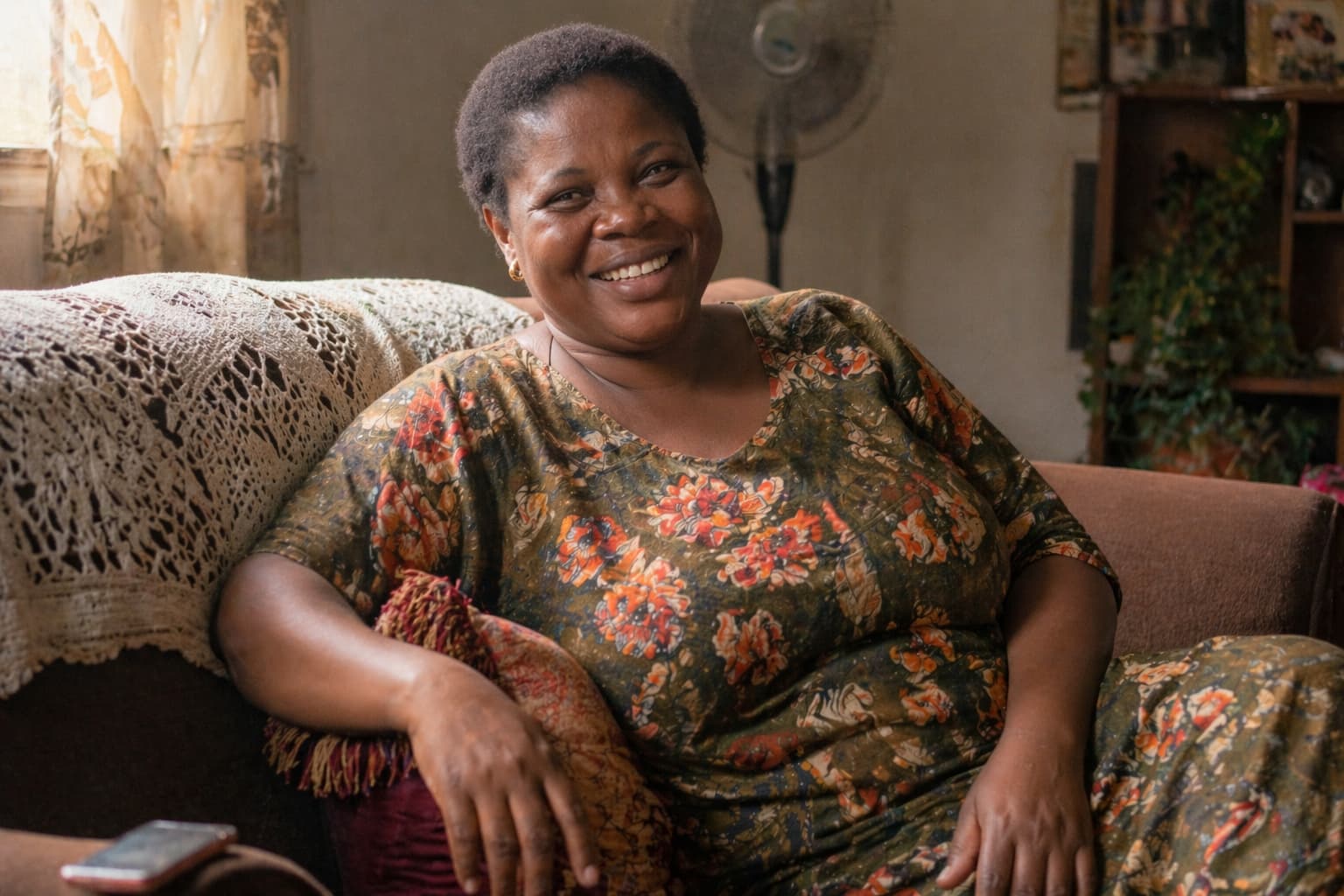
Her name was Mama Nnenna. She was 67 years old. Emeka’s grandmother’s younger sister. White hair, a posture so straight it shamed women half her age, and a gaze that felt like it could read you from across the room.
Before hospitals became common in her town, she was the community’s traditional birth attendant — the woman called when a baby was coming, when a birth was complicated, and in the weeks and months after birth, when a new mother’s body needed to be carefully restored. She had attended over 200 births across four decades.
She sat down with us, accepted a small plate of food, listened quietly for a few minutes. Then she put her plate down and spoke.
“See how you women are suffering. You push a whole child from your body and two months later you are punishing yourselves with starvation and those rubbish waist belts. In my time, we didn’t do that. After a birth, we fed the mother. Not anyhow feeding — specific foods, specific preparations, specific timing. We used the binding technique with shea and herbs that signalled the womb to close and the belly to draw back. We knew which foods dissolved postpartum fat and which ones locked it in. Every woman I attended came back to her body. Most came back better than before. But nobody is teaching this anymore. The hospitals say take paracetamol and rest. The Instagram people say starve and do sit-ups. And you young women are suffering for nothing.”
— Mama Nnenna, 67 · Traditional Birth AttendantThe room was completely silent. Every woman was leaning forward.
“Mama, please. Tell us what to do,” someone whispered.
She looked at all of us. Then she nodded. “Bring your notebooks.”
That Afternoon in Enugu
Mama Nnenna spoke for over two hours.
She told us which foods she gave to new mothers and specifically how they were prepared to maximise the body’s natural postpartum reset hormones.
She described the traditional belly binding technique — done with a specific combination of shea butter, three local herbs, and a cloth wrap applied in a particular sequence for 20 minutes each morning — that she had used to restore the waistlines of hundreds of women.
She told us which common foods in every Nigerian kitchen actively block postpartum fat release, and which foods replace them.
She described the womb-warming tea brewed from three ingredients available in any market — the foundation of postpartum recovery that her own mother had taught her.
And before we left, she said: “Your body is not broken. It is waiting for the right instructions. Give it what it needs and it will come back to you. Faster than you think.”
I promised her I would write it exactly as she taught. No shortcuts. And that is how this guide was born.
The First Week: Doubt
I returned to Lagos with four pages of notes and a heart split between hope and scepticism.
The next morning, I went to the market. Everything Mama Nnenna listed was available — common ingredients, nothing exotic, nothing imported. Total cost: under ₦3,500.
Day 1. I followed the protocol exactly. Day 2. Day 3. Nothing visible. Day 5 — still the same.
Mama Nnenna’s words echoed: “Postpartum fat was built slowly over nine months. Don’t insult your body by expecting it to release in five days. Give it the signal. Consistently. It will respond.”
So I continued.
On the 9th morning, I tied my wrapper to go to the kitchen and noticed something. The wrapper — which I always pulled extra tight — needed less pulling.
I walked to the bathroom mirror, lifted my blouse, and looked.
Not a dramatic change. But a subtle, unmistakable shift. The softness below my navel was visibly less pronounced.
My hands went to my waist. The indentation was back. Small. But there.
“Is this actually working?”
Day 13. I tried on a pair of trousers I hadn’t worn since before my pregnancy. They went past my hips. They needed a belt — but they went past my hips.
Day 16. Emeka crossed the room, put his hands on my waist, and held me there for a moment. A real hold. The kind I hadn’t felt in almost a year. He pulled back and looked at me. “Are you losing weight? Something is different.”
I smiled. “I’m just taking care of myself.”
Day 21. My mother-in-law: “Kemi, what are you doing? Your stomach is going down. You look like yourself again.”
My best friend Ngozi grabbed my arm at the market: “Kemi! Your waist is coming back! What are you doing?!”
The Night That Made Me Cry — The Good Kind
Four weeks into the protocol. Emeka surprised me with dinner reservations — just the two of us, first time without Tobenna since the baby came.
I stood in front of my wardrobe and pulled out a dress I had bought one week before I found out I was pregnant. A wine-coloured fitted dress I had kept like a promise to myself.
I put it on. It fit. Not just fit — it sat on me the way it was designed to. A visible waist. A flat lower stomach. The silhouette I thought I’d lost permanently.
I stood in front of the mirror and I cried. Quiet tears — the kind that come when something you’ve been praying for finally comes true.
On the drive home, Emeka said: “Tonight reminded me of our first dates. When I couldn’t stop staring at you.”
I looked at him. “What changed?”
He shook his head slowly. “Nothing changed. You just look like you again.”
That sentence stayed with me the whole ride home. Because that was exactly what I had lost. And exactly what I had found. Not a different body. My body. Back. In four weeks.
I’m Not the Only One
After my transformation, I shared Mama Nnenna’s method with every woman who asked.
Emeka’s cousin who had twins and started the same week as me? After 5 weeks: “Kemi, my husband looked at me this morning the way he looked at me before the babies. I started crying in the kitchen. I haven’t felt that in eight months.”
A colleague 14 months postpartum who had given up hope? Three weeks later: “I tried on my wedding dress last Sunday just to see. It zipped. It actually zipped. I sat on the floor and called my mother.”
A member of my new mothers WhatsApp group whose mother-in-law had been making painful comments? Four weeks later: “Mama came to visit and said ‘my daughter, your body is returning.’ The same woman who was shaming me three months ago.”
Same method. Same ingredients. Different women, different body types, different ages. Same results.
Why Am I Sharing This?
After my own transformation, I made a decision.
No woman should have to go through what I went through.
No new mother should lose herself, her confidence, her husband's desire, her sense of identity, because no one ever told her that her body is not broken. It just needs the right signal.
No postpartum woman should waste money on waist trainers, slimming teas, and gym plans designed for women who haven't just grown and delivered an entire human being.
So I went back to Enugu and sat with Mama Nnenna again.
I asked her permission to write everything down and share it with the women who needed it.
She agreed on one condition: "Write it exactly as I taught you. Don't change it to fit their impatience. The method works only if followed correctly."
I promised her. And that's how this guide was created.
Introducing: Mama Nnenna’s Postpartum Reset Protocol
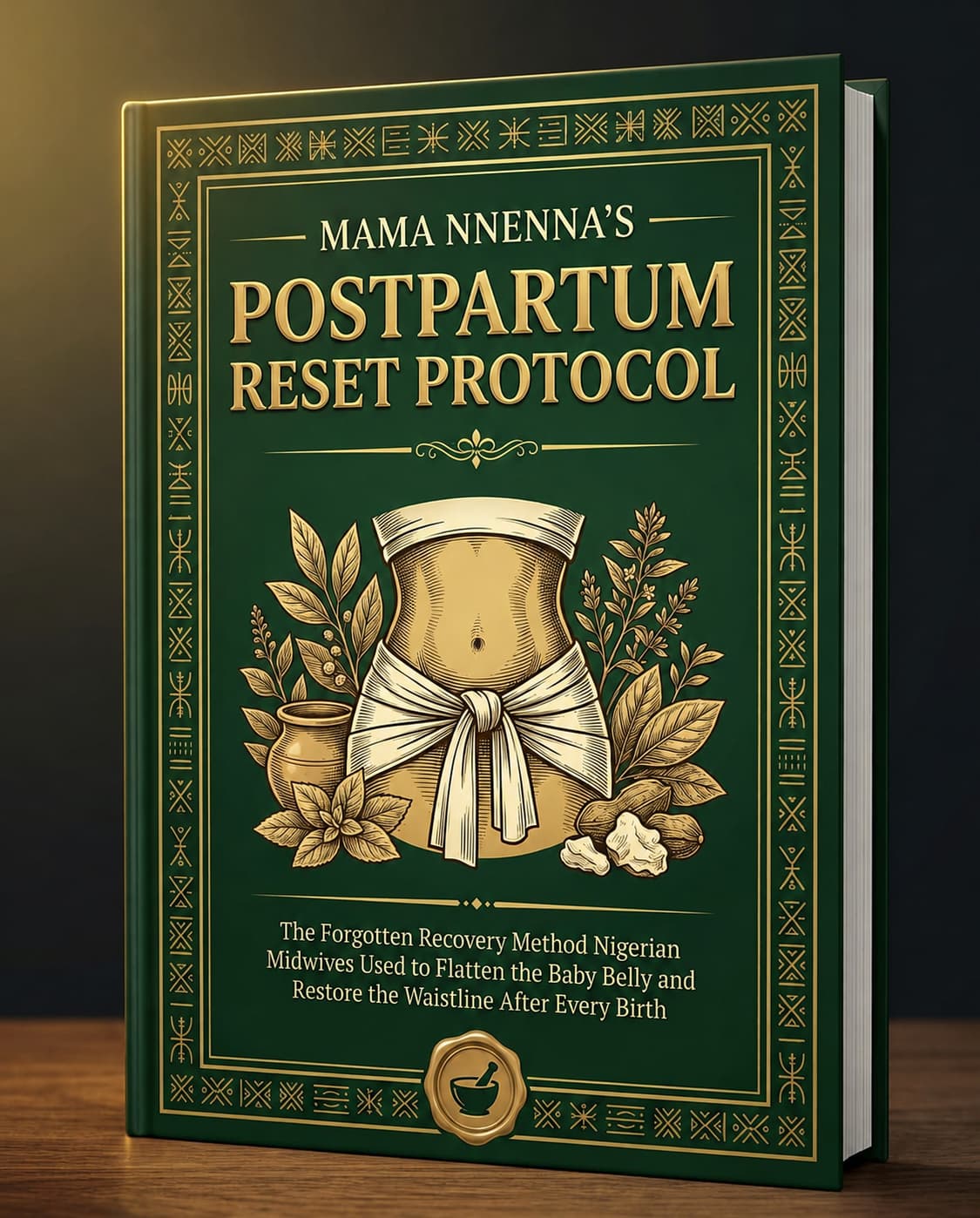
“The Forgotten Recovery Method Nigerian Midwives Used to Restore New Mothers’ Bodies, Melt Baby Weight, and Return Women to Themselves — Without Surgery, Starvation, or Exhausting Gym Routines”
Everything Mama Nnenna taught us — every food, every preparation, every technique, every instruction — inside one complete, easy-to-follow guide.
- Why postpartum fat is hormonally different from regular fat and the specific body signal that releases it — the single piece of information every new mother needs and nobody tells her (Page 4)
- The exact postpartum eating protocol Mama Nnenna used with her mothers — specific Nigerian foods, how to prepare them, when to eat them, and the combinations that activate your body’s natural fat-release hormones (Page 8)
- The 5 “Restoration Foods” — common market ingredients that specifically target postpartum belly fat and waistline recovery (Page 13)
- The 3 foods in every Nigerian kitchen that LOCK postpartum fat in place — making it nearly impossible to lose no matter how much you exercise — and exactly what to replace them with (Page 17)
- The traditional belly binding method — shea butter, local herbs, and a specific wrap sequence that signals the belly to draw back. Done in 20 minutes every morning (Page 21)
- The Womb-Warming Tea — brewed from three ingredients in any Nigerian market, forms the foundation of postpartum hormone recovery and accelerates fat release from week one (Page 26)
- The Waistline Restoration Protocol — specifically targets lower belly and love handles without crunches, starvation, or anything that depletes a breastfeeding mother (Page 30)
- How to maintain your results permanently — Mama Nnenna’s “maintenance method” keeps restored mothers looking their best for years after the protocol ends (Page 34)
You don’t need to travel to Enugu. You don’t need a gym membership. Everything you need is in your local market. Total ingredient cost: under ₦3,500.
Compare that to:
| Waist trainers: ₦12,000–₦45,000 | Compression only. Zero fat loss. Gone the moment you take it off. |
| Slimming teas: ₦6,000–₦15,000 | Laxative effect. Disrupts breastfeeding. Zero lasting results. |
| Postpartum gym + membership: ₦20,000–₦50,000 | Cortisol-spiking. Unsustainable. Designed for non-mothers. |
| Nutritionist consultations: ₦15,000–₦40,000/month | Expensive, recurring, generic. |
| Cosmetic surgery / lipo: ₦500,000–₦3,000,000+ | Recovering from surgery while caring for a baby is a nightmare. |
| The real cost of doing nothing: | Your confidence. Your husband’s attention. Your identity as a woman, not just a mother. |
This protocol costs less than what you spend on snacks in a week. Yet has the power to give you your body — and your life — back.
What Did It Cost to Put This Together?
| Travel to Enugu for multiple sessions with Mama Nnenna | ₦38,000 |
| Medical consultant (postpartum nutrition) to verify breastfeeding safety | ₦50,000 |
| Health writer to organise the information clearly | ₦35,000 |
| Testing with a group of postpartum mothers to confirm results | ₦30,000 |
| Professional design and guide production | ₦20,000 |
Total: over ₦173,000. Not counting the ₦115,000 I personally wasted. Or the year of frustration. Or the quiet damage to my marriage.
A fair price for this guide would be ₦25,000. But I know what it feels like to be desperate, exhausted from a new baby, and watching your budget. So if you take action today…
What Real Mothers Are Saying
Verified results from women who followed the protocol.
I’ll be honest — when I paid I was not hopeful at all. I had already tried 3 things and nothing touched my belly. By Day 9, my work skirt was fitting differently. I grabbed my measuring tape. I had lost 6cm from my waist in 19 days. My lower belly was visibly flatter. That morning my husband stopped when he saw me and said “good morning, beautiful” — he hadn’t called me beautiful unprompted since before my pregnancy. I cried on my way to work. ₦9,600 and 19 days. God bless Mama Nnenna. This is real.
My specific problem was the lower belly pouch — the one below the navel that just refuses to move even when you lose weight everywhere else. I had accepted it as permanent. Three and a half weeks in, I could see my lower abdomen properly for the first time since before my pregnancy. My husband touched my stomach and said “follow it forever.” I laughed and cried at the same time. The only thing that has EVER touched that area. The only one.
Two years postpartum and the weight from my second pregnancy never left. My doctor kept saying “just exercise more” — with two children under four! Four weeks on this protocol and I went to the market, tried on a size 16 trouser just to see. It fit. I cried in the fitting room. A stranger at the stall said “madam you have a nice figure.” Me. Hiding under oversized blouses for two years. Taking off one star only because I wish I had found this sooner — two years I suffered unnecessarily.

I was 8 months postpartum and my husband had quietly stopped complimenting me the way he used to. I noticed it but was afraid to say anything. By week 3 on the protocol he walked into the room one evening, looked at me, and said “you’re glowing. What changed?” By week 4, my jeans from before my pregnancy actually closed. I stood in the bathroom and just kept saying thank you. My marriage feels like it did in our first year again.

As a Northern Nigerian woman I was worried the meal plan would not suit Hausa food. I was wrong — there are options that work with tuwo, miyan kuka, everything. I found all the herbs at Wuse market in one afternoon. What I did not expect was how my energy changed. I had been bone-tired since I gave birth. By Day 12, I was waking up before my baby. By week 3, my waistline was visibly returning and my energy was almost what it was before pregnancy. Alhamdulillah. Every postpartum woman needs to know about this.
WAIT — Special Bonuses For The First 15 Women Today
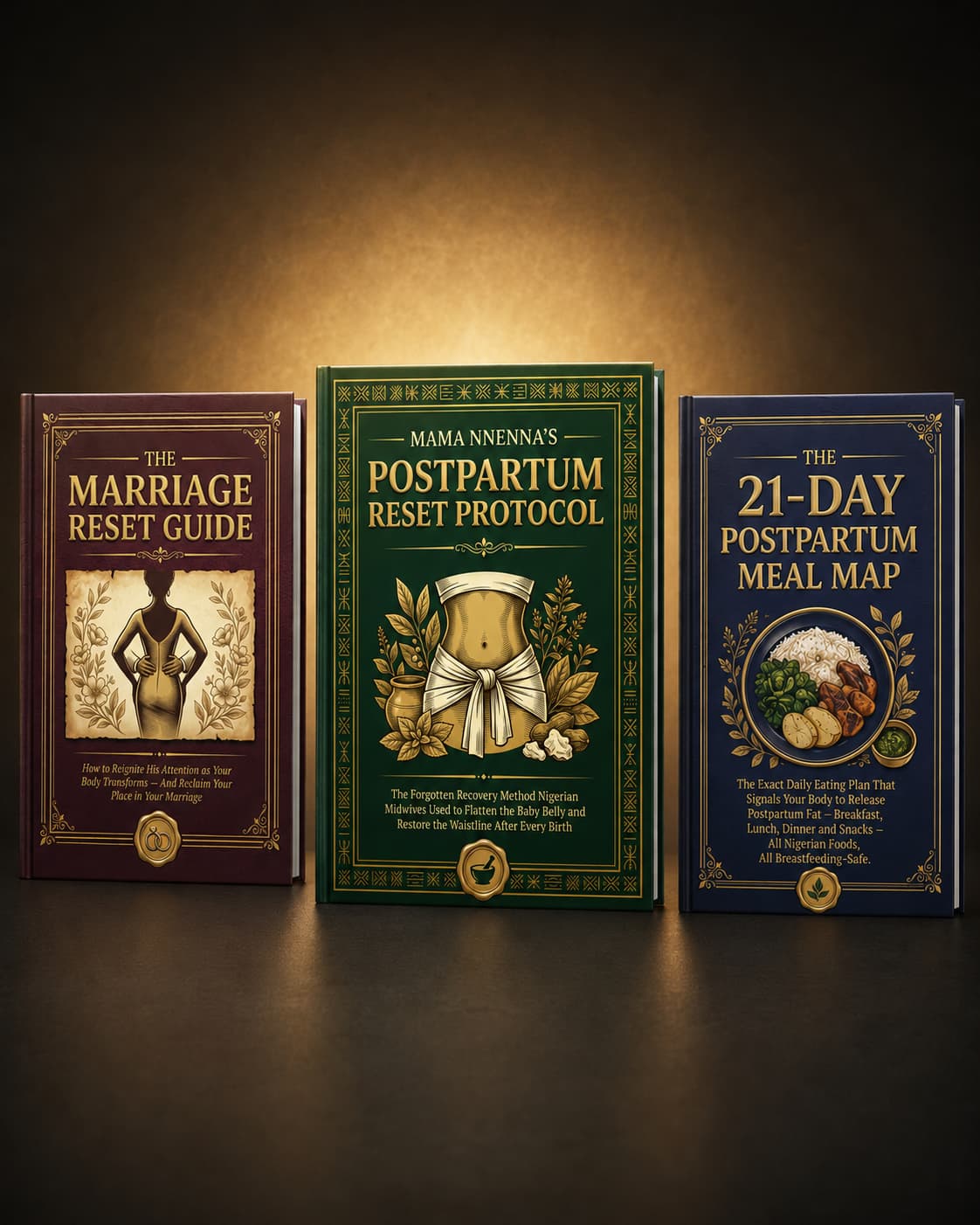
If you’re among the first 15 women to get this guide today, you’ll also receive 2 powerful free bonuses:
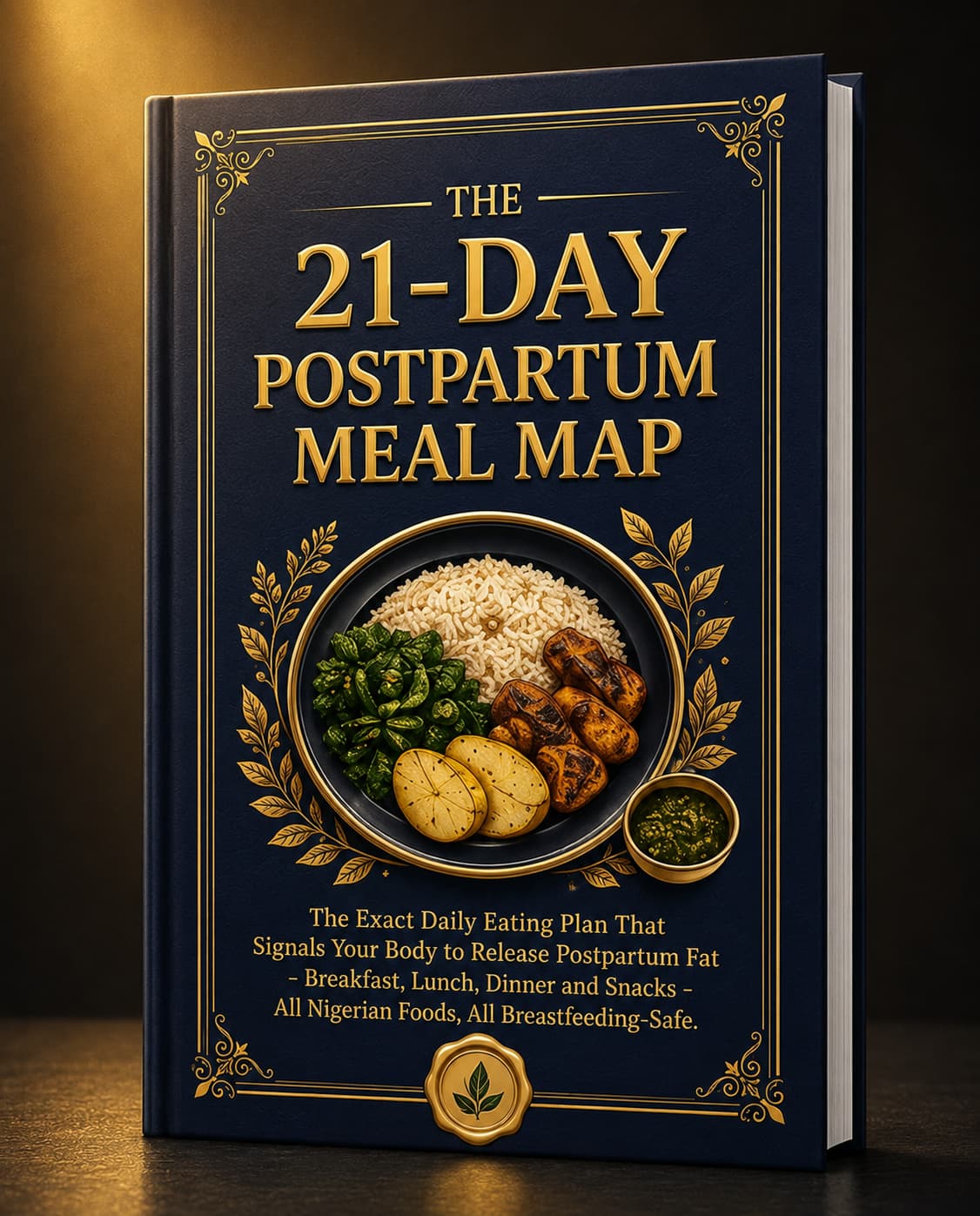
BONUS #1: The 21-Day Postpartum Meal Map
(Value: ₦7,500) — YOURS FREE TODAY
A done-for-you daily eating plan for 21 days. Breakfast, lunch, dinner, and snacks. All Nigerian foods. All breastfeeding-safe. Budget under ₦3,000 per day. Full market shopping list with local names. Zero guessing — open the plan, see today’s food, cook and eat.
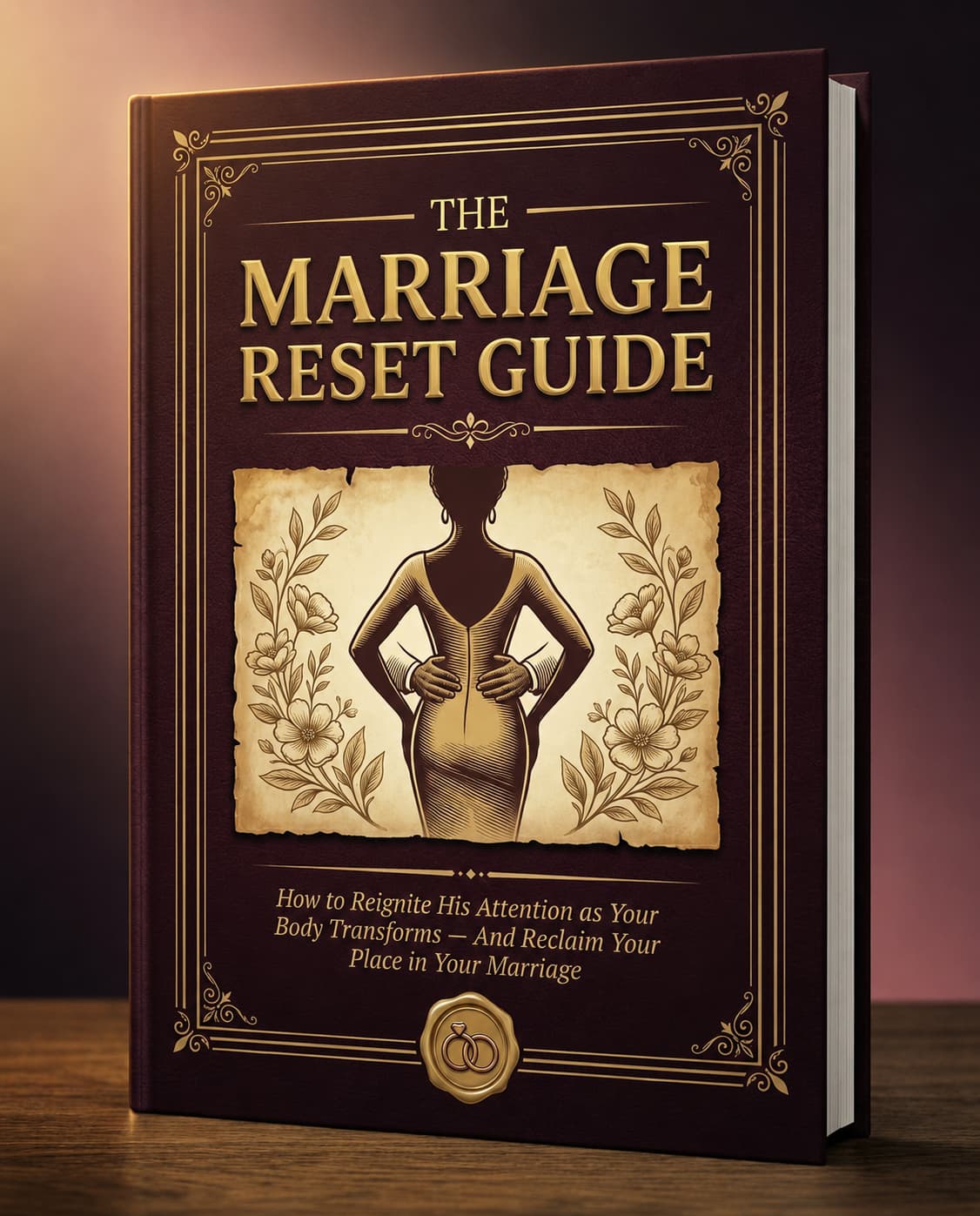
BONUS #2: The Marriage Reset Guide
(Value: ₦8,000) — YOURS FREE TODAY
The honest guide for the Nigerian wife who knows her marriage has cooled since the baby came. How to show up powerfully in your marriage as your body changes, reignite his desire, and reclaim your place — not as a desperate woman, but as a woman who got herself back.
NOTE: Other women are seeing this page at this very moment.
You Have Absolutely Nothing to Lose
Get the Postpartum Reset Protocol today
Follow the protocol exactly for 21–30 days
Track your waistline, belly, and how your clothes fit
If your belly isn’t reducing… if your waistline isn’t returning… if your clothes aren’t fitting differently… send me an email and I’ll refund every single kobo of your ₦9,600. No questions asked.
You’ve already spent so much on things that didn’t work. This time, you risk absolutely nothing.
Right Now, You Have Two Choices
Option 1: Close this page and continue as you are
- Continue wearing the same loose blouses that hide what you don’t want anyone to see
- Continue feeling like a mother who lost herself and doesn’t know how to find her way back
- Continue watching your husband’s eyes drift to women whose bodies haven’t been through what yours has
- Continue lying awake wondering if your pre-baby body is gone forever
- Continue spending money on waist trainers and teas that drain your budget and your hope
(Nothing changes unless you change it.)
Option 2: Take action right now
Imagine 4 weeks from now. You’re getting dressed for an outing. You reach past the loose blouses. You pull out the fitted dress.
- It fits. Not just fits — it hugs. A waist. A flat belly. A silhouette you recognise.
- Your husband stops mid-sentence when you walk into the room
- He looks at you — really looks — the way he used to look at you before
- Your friend whispers “what are you doing to your body?!” with pure jealousy
- You look in the mirror and see YOU again. Not the postpartum version. You.
This is not a fantasy. This is what is waiting for you.
Questions Mothers Ask Before Getting the Protocol
However — if you’ve had a baby, even 2 or 3 years ago, and your weight has never quite been the same since, then yes, this is absolutely for you.
One Last Thing Before You Go…
I want you to imagine something.
It’s one month from now. A Saturday morning. Emeka is still asleep. The baby is quiet.
You walk to the bathroom. You look in the mirror before anyone else wakes up.
And you see something you haven’t seen in over a year.
A waistline. A flat belly. Your silhouette.
Not someone else’s body. Not a before-and-after from Instagram. Your body. The one that was always there — underneath everything — waiting to come back.
You go back to the bedroom. Emeka opens his eyes. He looks at you.
And he smiles. That smile. The one you thought was gone.
He reaches out and puts his hand on your waist.
And you think: This is who I am. This is who I’ve always been. I just found my way back.
That moment is real. It is waiting for you. All you have to do is take the first step.
YES! I WANT MAMA NNENNA’S POSTPARTUM RESET PROTOCOL + BOTH BONUSES — ₦9,600See you inside sis.
Your body is not broken. It is not gone. It is not lost.
It is waiting for the right instructions.
P.S. You have a full 40-day money-back guarantee. Either this protocol works and your belly starts flattening and your waistline starts returning… or you get every kobo back. Zero risk.
P.P.S. Only — spots at ₦9,600. After that, the price returns to ₦25,000. Don’t let someone else take your spot while you’re thinking about it.
P.P.P.S. Every week you wait is another week in oversized blouses. Another evening where the distance between you and your husband quietly grows. Another morning you avoid the mirror. The best time to start was 12 months ago. The second best time is right now.
New Mama. Real Talk. — With Simi · For The Modern African Mum
Disclaimer: This guide contains traditional wellness and nutritional information shared for educational purposes. Individual results may vary. This is not a substitute for professional medical advice. Breastfeeding mothers with specific medical concerns should consult their healthcare provider before starting any new nutritional protocol.