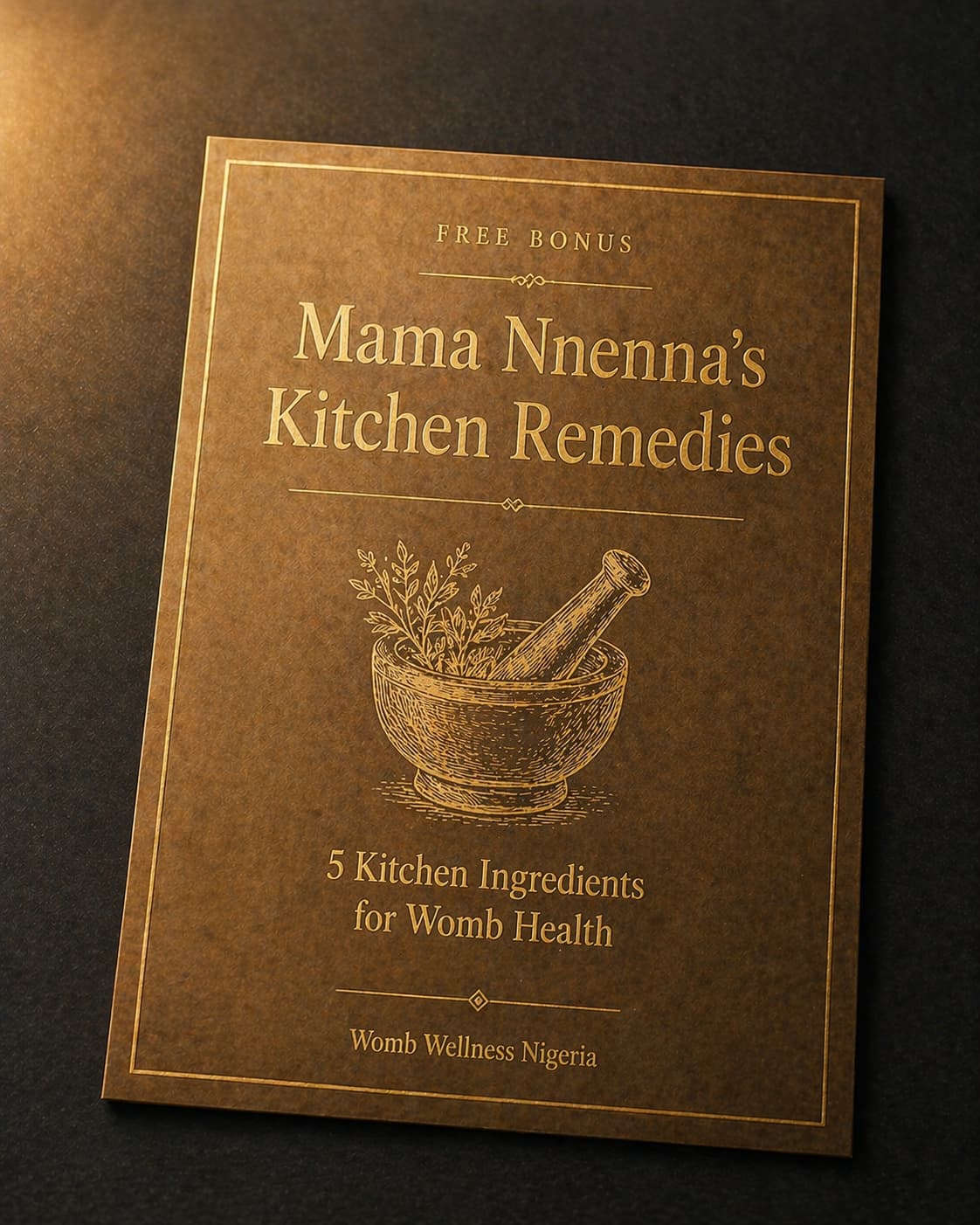
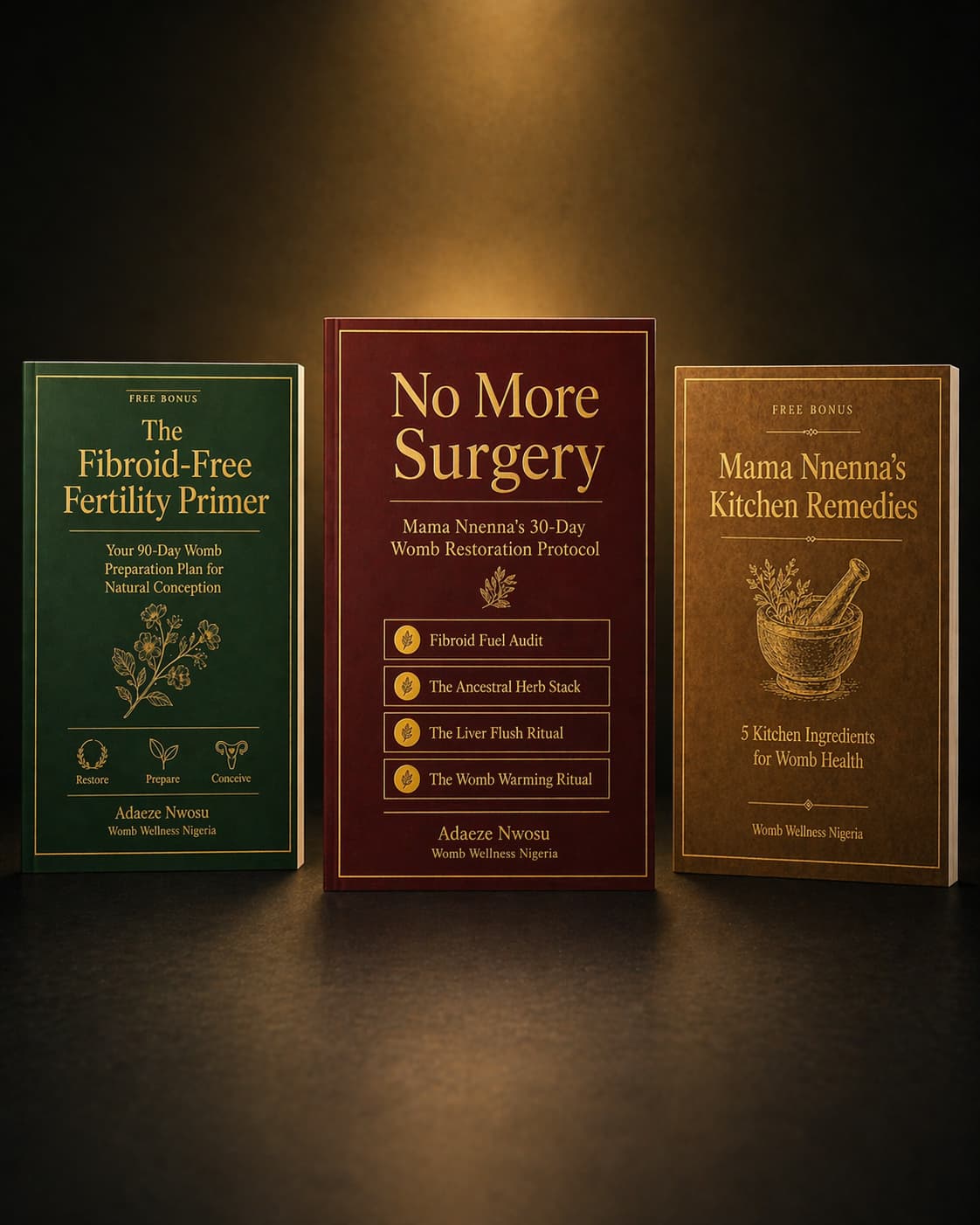
You stopped telling people how you really are.
When they ask, you say "managing." You have been saying managing for so long it has started to sound like the truth.
You manage the heavy days. You manage the stomach that is not quite your stomach anymore. You manage the appointments, the scan results, and the word that keeps appearing at the end of every sentence your doctor speaks.
Surgery.
And in between managing and smiling and planning your life around your cycle, there is a private grief that has no name. Not dramatic enough to cry about in front of anyone. Not small enough to ignore. Just — there. Sitting quietly in your chest on Sunday mornings when you are getting dressed and the blouse you loved last year does not sit the way it used to.
You are 34 years old. You have a husband who loves you. A career. A faith. A life you have built carefully. Why does your body feel like it is working against all of it?
You check what you are wearing before you sit down anywhere. You sleep with an old wrapper underneath you. You carry extra pads in every bag — the big ones, not the regular ones. The ones that should be enough but never quite are.
You have set an alarm at 2am so many times it has become normal. You have ruined clothes you never talk about. Good dresses you don't wear anymore. Church clothes. Work clothes. A white blouse that never came clean.
The doctor has said the word more than once now. With a chart. With measurements. With the calm clinical certainty of someone for whom surgery is a solution and not a last resort.
You have tried. God knows you have tried. You have spent money. You have followed instructions. You have fasted and prayed and researched at midnight when everyone else was asleep. And every time something almost worked — it stopped. And you were left exactly where you started, lighter in your pocket, heavier in your heart.
Is this just my life now?
That thought — the one you push away every time it surfaces — is the one I want to speak to directly.
Because it is not your life. And what I am about to share with you is the reason I know that for certain.
Drop everything you are doing now and read every word on this page.
I was diagnosed three months after my wedding.
August 2020 — Emeka and I got married. By November I was sitting in a gynaecologist's office in Surulere being told I had multiple uterine fibroids. I was 31 years old. I had only just stopped telling people we were still settling in.
The doctor explained everything carefully. What fibroids are, where they form, why some women get them. She mentioned hormones. She mentioned genetics. She mentioned surgery — not immediately, she said, but eventually, probably. She said "we will monitor."
I nodded. I went home. I sat in my car outside our compound for forty-five minutes before I went upstairs.
The first year, I told almost no one.
My periods had always been heavy. Now they were heavy in a way I did not know was possible. Flooding through thick pads in two hours. Clots that frightened me. Cramps that kept me flat on my back the first two days of every cycle — paracetamol, hot water bottle, and prayers while students' test scripts sat unmarked in my bag.
By early 2022, my stomach had begun to swell visibly. I started wearing looser blouses and telling myself it was normal weight fluctuation. You know how you lie to yourself when you are not ready to face something.
One morning over breakfast — we had been married almost two years — Emeka looked at me across the table and said quietly: "Ada, I want us to try for a baby. But I'm scared for you."
He didn't say anything cruel. He didn't need to. Those seven words carried the full weight of everything we hadn't discussed — the swollen stomach, the cancelled plans, the appointment I kept postponing, the word surgery neither of us wanted to say out loud.
He was scared for me. And I didn't know how to tell him I was more scared for us.
That was one of the worst mornings I can remember. Not because anything dramatic happened. Just because it was so quiet and so ordinary — and we had both, without realising it, started managing around a problem instead of living through it together.
I spent years looking for answers. Here is what I tried — and why each thing failed:
1. Hormonal contraceptives (Provera) — prescribed to reduce bleeding. They helped slightly but I gained 6kg in four months and my mood went somewhere dark. I stopped after four months.
2. A herbal fibroid tea from a Lagos Instagram vendor — eleven weeks. ₦18,500 every month. Beautiful testimonials. A whole highlight reel. By the third order she responded three days late. By the fourth, nothing. She had moved to her next campaign. My fibroids had not moved anywhere.
3. No-red-meat, no-dairy diet — six weeks, strictly followed. My mother-in-law served egusi with stockfish at Sunday lunch and looked genuinely confused when I refused. Six weeks. Nothing changed.
4. Fibroid shrink capsules from a Surulere pharmacy — ₦12,000 for a 30-day supply. "Come back in a month," the pharmacist said confidently. I came back. He sold me another pack. I did not return a third time.
5. Prayer and fasting — three separate months. God gave me real peace during those periods. But when I returned to the ordinary days, the bleeding returned with them. Spiritual strength does not shrink a fibroid. I know that now.
6. A naturopath consultation in Victoria Island — ₦45,000 for the consultation and a supplement package. Kind and thorough. When the supplements ran out after six weeks there was no follow-up. No "now do this." Just silence.
Three years. Six attempts. And I was standing in the same place I had started — except older, and with less faith that anything would change.
By the time I was 33, I had quietly stopped telling Emeka what I was trying. I would just try things. And stop. And not mention it. Because the moment of hope before each attempt was becoming harder to access. And the crash afterward was becoming something I didn't want him to watch.
December 2023. Emeka's family Christmas gathering. Festac, Lagos.
His family always does Christmas in the same compound in Festac — the same pepper soup Mama Emeka makes from scratch, the smell of jollof rice and fried chicken thick in every room, the same aunties asking questions that are not really questions, children running between chairs until someone carries them to bed.
By 9pm the younger crowd had moved outside where someone was playing Burna Boy too loudly. The older guests retreated to the sitting room. I slipped into the kitchen to wash dishes — partly to be helpful, mostly to be alone.
There was a woman already at the sink.
Short. Wide-shouldered. Head tie knotted with the quiet precision of someone who has been tying head ties since before I was born. She moved with the unhurried certainty of a person who has never been in a rush in her life. Emeka's aunt had introduced her briefly earlier — Mama Nnenna, an old family friend, just visiting from her son's place.
We washed dishes together for maybe ten minutes without speaking. The sound of running water, the low hum of conversation from the sitting room, the occasional burst of laughter from outside. She hummed something softly — not a song I recognised, more like something you hum to yourself when you are thinking.
Then she looked at me. Not quickly. Properly. The way older women look at you when they are reading something you haven't said out loud.
She looked at my stomach — I was wearing a loose blouse, but the swelling was visible to anyone who knew what to look for — and then she looked at my face. And she asked, quietly:
"How long?"
I did not pretend I didn't understand the question.
"Three years," I said.
She nodded slowly. Then she clapped her hands once — a single sharp flat sound — and said:
"Sit down. Let me tell you what your doctors do not know how to tell you."
She spoke for almost an hour. I want to share what she told me the way she told it — not in the language of doctors, but plainly.
"Fibroids grow on oestrogen. That is all they eat. You stop feeding them oestrogen, you starve them. Your doctors know this. But they do not tell you how to do it without cutting."
She said most Nigerian women — without knowing it — are flooding their bodies with oestrogen daily. Through the wrong cooking oils. Through processed foods. Through toxins the liver cannot clear fast enough. And the liver, she said, is the key to everything.
"Your liver is the one doing the work," she said, leaning forward slightly. "If the liver is blocked — if it cannot clear the old hormones — they stay in your blood. And fibroids drink them. That is why your herbal teas did nothing. They were treating the womb. Nobody was cleaning the liver. You cannot repair a room when the drain is blocked."
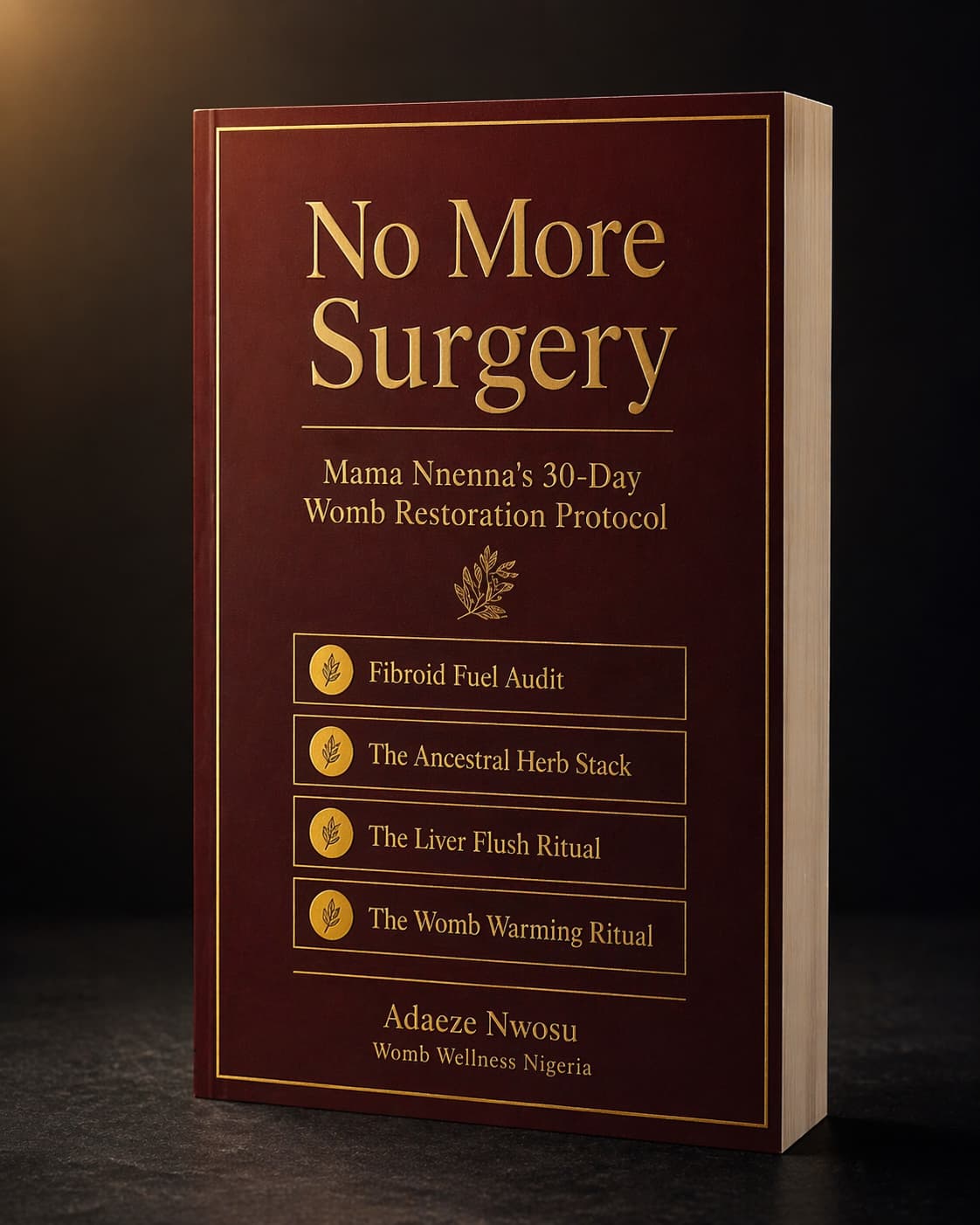
She described four things — not twelve, not thirty, four — that she had used with women for more than 35 years. Remove the specific foods feeding the fibroids. A combination of five local herbs taken every morning in a precise sequence. A three-ingredient liver flush drink taken daily. A womb warming compress — castor oil on the lower abdomen, three evenings per week.
"Your grandmother did this," she said about the compress. "Ask her. If she is still alive, ask her. She will know."
I sat there looking at this woman and thought: this cannot be it. I have spent years looking and the answer is castor oil and herbs?
I said as much. Politely.
She smiled — the slow, patient smile of a woman who has heard that reaction many times. "Simple is what works," she said. "Complicated is what sells."
Before she left that night she wrote everything down on pages torn carefully from a small notebook in her bag. She handed them to me at the door. I folded the pages and put them in my bag. I want to be honest: I didn't fully believe it. But I kept the paper.
I started on January 3rd, 2024. Not from confidence. From stubbornness. ₦1,200 worth of ingredients from my local market. Thirty days. I will see this through.
The first week — nothing. By Day 5 I was already telling myself: another one.
Then Day 8.
I got dressed for work. I pulled on a fitted blouse I had not worn in over a year because of how it pulled across my stomach. I did it up. I walked to the mirror expecting to reach for the buttons.
The blouse fit.
Not dramatically. But the tight pull across the lower belly — the one I had stopped noticing because I had accepted it — was gone. I stood in front of the mirror and pressed my hand gently to my stomach.
Something had shifted.
By Day 14 I was sleeping through the night without the low-level anxiety I had carried so long I had forgotten it was there.
On Day 19, Emeka and I were watching television after dinner. He reached over without saying anything and placed both hands flat on my stomach. The way you touch something when you are checking if it is real.
He said: "Ada, your belle don go down o. Wetin you dey do?"
I laughed and told him I had changed my eating.
He looked at me for a long quiet moment. Then: "Whatever it is — keep doing it."
That was the first time in two years he had touched my stomach without me flinching.
I completed the 30 days on February 2nd. My February period came on schedule. Five days. Normal flow. No flooding. No clots. No alarm set the night before.
I sat in the bathroom on Day 2 of that cycle and cried. Not from pain. From relief. The kind that is so large it comes out as something else entirely.
The results that came back from women I shared the protocol with — different women, different cities, different fibroid histories — all carried the same thread: something is changing.
I could not keep sharing Mama Nnenna's handwritten notes individually. I am a schoolteacher with lesson plans and marking and a husband who wants supper.
So I did what made sense. I documented everything properly. I validated every step with a certified Lagos nutritionist. I ran a testing phase with 11 women across Lagos and Abuja before making this available to anyone.
And now I am putting it in your hands.
🔒 Secure Checkout • Prelaunch Price: ₦9,600 • 30-Day Money-Back Guarantee • Guide Delivered on Launch Day